
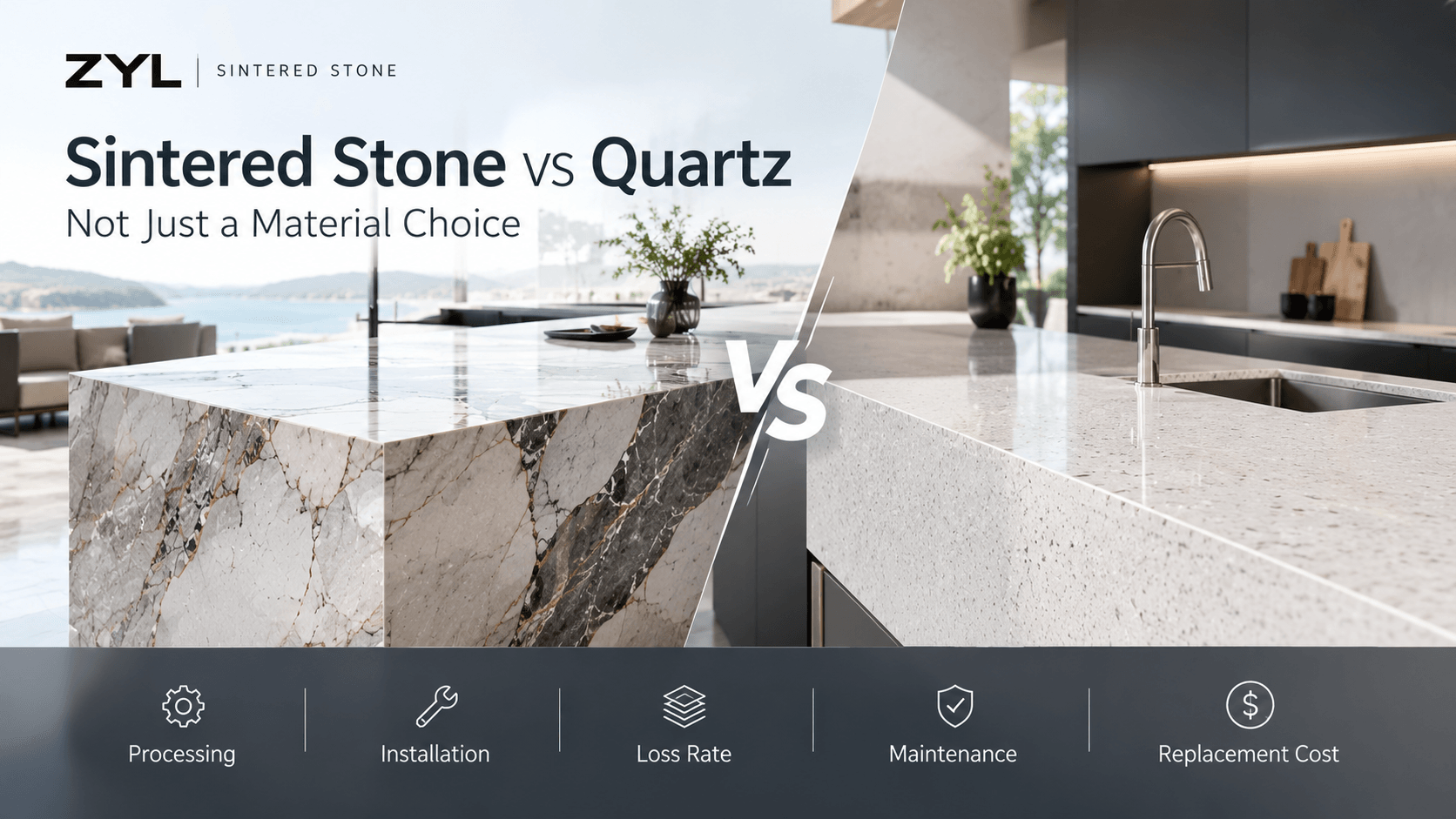
Sintered Stone or Quartz? Which Costs Should Project Buyers Compare?
Choose by application and compare performance, fabrication, installation, waste, maintenance and replacement costs rather than material price alone.
There is no simple winner between sintered stone and quartz for every project. Comparing only wear resistance, color or material price per square meter can overlook fabrication methods, design requirements, corner risks, site installation and future repair. A more practical approach starts with the application and compares complete solutions.
First define where the material will be used
Kitchen worktops, commercial reception counters, wall finishes, cabinetry, public spaces and outdoor applications have different requirements. List usage frequency, impact risk, sink or hob cutouts, need for large-format continuous veining and outdoor exposure before filtering materials and thicknesses.
Fabrication and shaping capability affect the finished result
Large-format sintered stone offers advantages in continuous veining and appearance, but edges, cutouts, cutting, handling and installation need careful process control. Quartz has established experience for some irregular fabrication and common worktop forms, but its patterns, dimensions and environmental suitability must still be confirmed by product. The material name alone is not enough.
Do not look only at the slab price
Even when material prices differ, compare fabrication waste, cutouts, edge finishing, waterfall edges, packaging, transport, installation, repair and replacement together. Complex details or an immature fabrication method can increase downstream costs for a material that appeared inexpensive initially.
Compare every option with the same checklist
For each solution, record the application, model, thickness, sample appearance, fabrication, support, expected waste, installation scope, cleaning and maintenance, and replacement difficulty. For special environments or structural uses, also review relevant technical documentation and system requirements.
Material selection is not about taking sides between sintered stone and quartz. It is about which material best fits the project's performance, fabrication, maintenance and budget. Comparing material, fabrication, installation and future maintenance together gives a more realistic installed cost.