
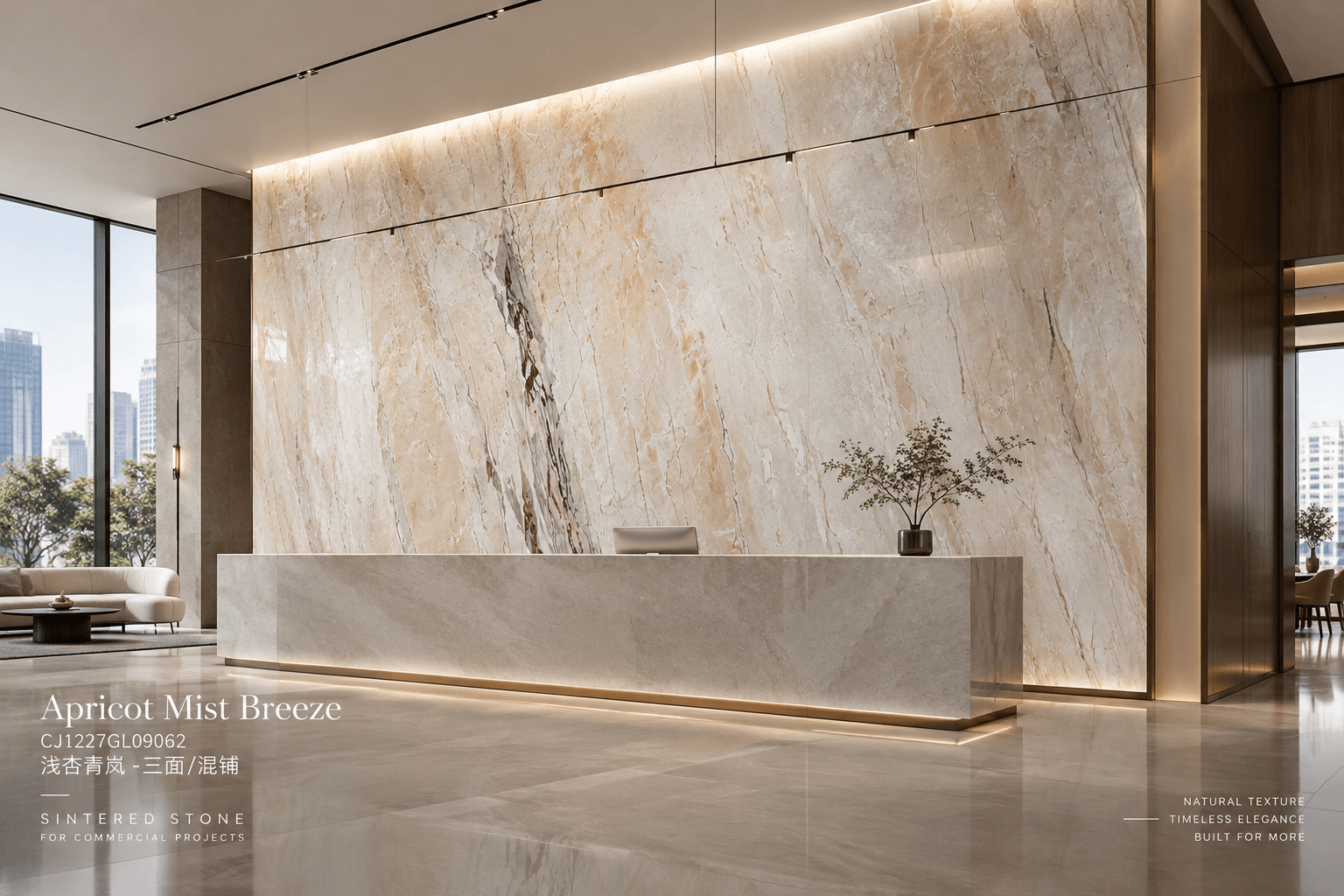
Is Luxury Sintered Stone Worth It for Commercial Projects? 5 Factors Buyers Should Compare
Compare slab size, marble-look coordination, application-specific thickness, verified durability and fire data, and total installed cost before specifying luxury sintered stone for a commercial project.
A project buyer is reviewing materials for a hotel lobby, a retail showroom, or a large residential development. The design calls for a marble look, but the specification team has several options: natural marble, porcelain tiles, and luxury sintered stone.
The question is not simply which material looks better.
Which one fits the project’s design, fabrication requirements, installation system, maintenance plan, and budget?
Luxury sintered stone is worth considering when a project needs large-format surfaces, coordinated finishes, and the visual impact of natural stone. But the right choice depends on more than appearance. Here are five factors worth checking before placing an order.
1. Slab Size Changes the Way a Surface Looks
One of the most noticeable differences between large-format sintered stone and conventional tiles is the number of visible joints.
A tiled feature wall may require dozens of individual pieces, depending on the tile size and wall dimensions. Each joint introduces another line into the design, and the overall appearance depends on tile alignment, grout colour, and installation accuracy.
Large-format sintered stone can reduce the number of visible joints significantly.
For example, a 3,200 mm-high feature wall may be designed around panels up to 1,600 × 3,200 mm, subject to the available product range and site conditions. Fewer panels can create a more continuous visual effect, especially when the surface features marble-inspired veining.
For hotels, retail spaces, reception areas, and premium residential interiors, this can make a real difference to the finished design.
However, fewer joints do not automatically mean easier installation. Large panels require careful measurement, handling, access planning, and substrate preparation. Doorways, elevators, corners, and installation equipment should be checked before the material is ordered.
What buyers should check: Confirm the actual slab dimensions, usable dimensions after fabrication, vein direction, joint layout, and whether the panels can be moved into the installation area.
2. Marble-Look Design Depends on More Than the Pattern
Luxury sintered stone is often selected to achieve the visual character of marble without using natural marble throughout the project.
Designs inspired by Calacatta, Statuario, and other distinctive marble styles can provide strong veining and a coordinated appearance across large surfaces.
But not every marble-look slab delivers the same result.
Some designs have relatively subtle patterns that work well across multiple panels. Others rely on bold veins, directional movement, or carefully matched bookmatched layouts. With the latter, panel selection and installation sequence become especially important.
It is also important to distinguish between a similar colour and a coordinated pattern. Two slabs from the same product range may have different vein positions, and a replacement slab may not reproduce the exact pattern used in the original installation.
For a large commercial project, reviewing one small sample is rarely enough to judge the complete visual effect.
What buyers should check: Request full-slab images where available, confirm the product code and surface finish, review the intended layout, and approve the actual material before fabrication. If bookmatching is required, confirm the sequence and matching direction in advance.
3. Thickness Must Match the Application
A common mistake in material procurement is assuming that one thickness can be used for every application simply because the colour is the same.
Sintered stone is available in different thicknesses, but the correct specification depends on how the material will be installed and used.
A thinner panel may be suitable for a designed wall-cladding system. A countertop may require a different thickness, edge detail, and support arrangement. Flooring, exterior cladding, and other demanding applications may involve additional design and installation requirements.
The material itself is only one part of the system.
For example, a countertop specification should consider the cut-outs for sinks and hobs, edge fabrication, cabinet support, overhangs, and the way loads are transferred through the assembly. For wall cladding, the substrate, fixing method, panel dimensions, and project conditions must also be considered.
Choosing a thicker slab does not automatically make an unsuitable installation safe. Likewise, a thinner panel should not be rejected without considering the intended system and manufacturer’s technical guidance.
What buyers should check: Confirm the exact product thickness, intended application, fabrication requirements, support conditions, fixing method, and relevant technical documentation before approving the specification.
4. Durability and Fire Performance Must Be Verified
Sintered stone is manufactured using mineral-based raw materials and high-temperature processing. Depending on the product, it can offer properties such as low water absorption, good resistance to staining, and resistance to heat and scratching.
These characteristics can make it a practical candidate for selected commercial and residential applications.
However, no single performance claim should be assumed to apply equally to every product.
Water absorption, breaking strength, abrasion resistance, chemical resistance, and other properties should be checked against the technical data for the specific slab. The finished result can also be affected by the surface finish, edge details, fabrication quality, and installation method.
Fire performance deserves the same attention.
Although mineral-based sintered stone products are generally non-combustible in nature, a project team should not assume that every product automatically carries an A1 classification under EN 13501-1. The applicable classification must be confirmed through the relevant test or classification documentation for the product being specified.
This matters when materials are being selected for hotels, hospitals, schools, transport facilities, and other projects with formal fire-performance requirements.
What buyers should check: Request current product-specific technical documents and fire-classification reports where required. Make sure the documents correspond to the product and application being considered, and confirm the project’s applicable requirements with the design team.
5. Compare the Installed Cost, Not Just the Slab Price
Luxury sintered stone may have a higher material cost than some conventional tiles. But the purchase price per square metre is only one part of a project budget.
A more useful comparison includes:
- Material cost and expected cutting waste
- Edge finishing, mitres, cut-outs, and other fabrication
- Packaging, transport, unloading, and site handling
- Installation labour and the required fixing system
- Substrate preparation and coordination with other trades
- Cleaning, maintenance, and potential replacement costs
Large-format panels may reduce the number of joints and individual pieces to install. At the same time, they can require specialised handling equipment, more careful fabrication, and tighter coordination on site.
The cost advantage therefore depends on the project layout, labour market, panel size, design complexity, and installation method.
A fair comparison should evaluate complete installed solutions rather than compare the slab price of one material with the finished cost of another.
For distributors and importers, supply consistency is another consideration. Product codes, thickness options, available stock, packaging standards, and the ability to coordinate repeat orders can all affect project planning.
What buyers should check: Ask suppliers to clarify what is included in the quotation, compare the same scope of work across materials, and confirm the availability of the required sizes, finishes, and quantities before committing to the project.
So, When Is Luxury Sintered Stone the Right Choice?
Luxury sintered stone is particularly worth evaluating when a project calls for large-format surfaces, marble-inspired designs, coordinated wall and countertop finishes, or fewer visible joints.
It is not automatically the best choice for every application. Natural stone, porcelain tiles, and other surface materials each have their own advantages, fabrication requirements, and cost considerations.
The better question is whether the selected product can meet the project’s visual, technical, installation, and budget requirements as a complete system.
For distributors, fabricators, and project procurement teams, the decision should start with the intended application, then move to product specifications, fabrication planning, supply availability, and installed cost.
At ZYL Sintered Stone, buyers can explore different colours, slab sizes, thicknesses, and surface finishes for residential and commercial projects.
Browse the ZYL Sintered Stone product catalog to review available designs and identify options for your next project. For project or wholesale enquiries, share your required dimensions, thickness, application, and estimated quantity so the suitable options can be checked.