
Where Do Hidden Cracks Most Often Occur During Large-Format Sintered Stone Transport and Handling?
Packaging, loading, site routes, equipment, personnel and temporary storage can all cause hidden damage and should be managed as one quality process.
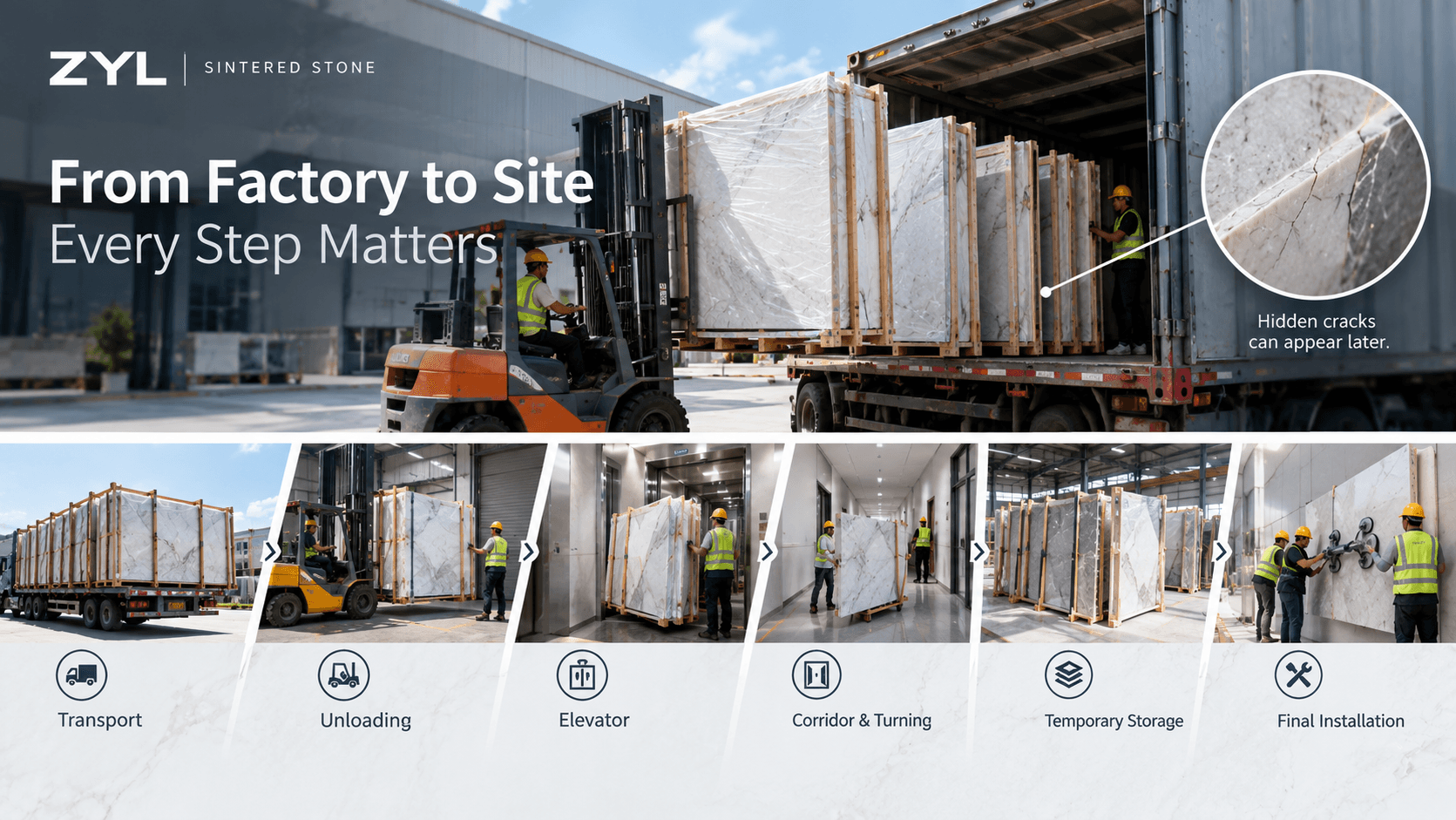
Large-format sintered stone is not damaged only beside the cutting machine. Loading, unloading, lift access, corridor corners, temporary storage and secondary handling before installation can expose slabs to impacts or twisting. Some damage is not obvious when it occurs and appears only after installation as cracks or chipped edges, so transport and handling belong in project quality management.
Start control with packaging and loading
Before dispatch, confirm slab dimensions, quantity, packaging and loading conditions. Use suitable A-frames or packaging structures for large slabs to prevent point loading, direct edge impacts and compression during transit. Loading, unloading and transfer methods must suit the slab dimensions and available site equipment.
Confirm the handling route in advance
During procurement and construction planning, check the unloading area, door openings, lift dimensions, corridor widths, corners, stairs and final installation location. If the route is unclear and the slabs cannot pass after arrival, improvised turning, tilting or repeated handling will increase damage risk.
Do not decide equipment and staffing at the last minute
The larger the slab, the greater the demands on handling tools, suction cups, support points and team coordination. Plan equipment and personnel according to dimensions, weight, route and site conditions; previous experience with a similar slab is not an assessment. Avoid twisting, corner impacts and unsupported overhangs during handling.
Incoming inspection and temporary storage
On arrival, promptly inspect packaging, surfaces, corners and visible cracks, and photograph and record any abnormal slab. Use a stable rack for temporary storage and follow product and packaging requirements. Avoid casual flat stacking, point support, unsupported areas and mixing with other materials.
What should be done after damage occurs?
Preserve the damaged condition, packaging, delivery note and site photos, and record when and during which handling stage it was found. Do not discard or fabricate a damaged slab immediately. The parties should confirm the damage and responsibility process before deciding on replenishment, repair or replacement.
Conclusion
Transporting large slabs is not merely a logistics task but a continuous process from factory packaging to final installation. Planning routes, equipment, storage and inspection in advance controls cost and delivery better than improvising after arrival.