
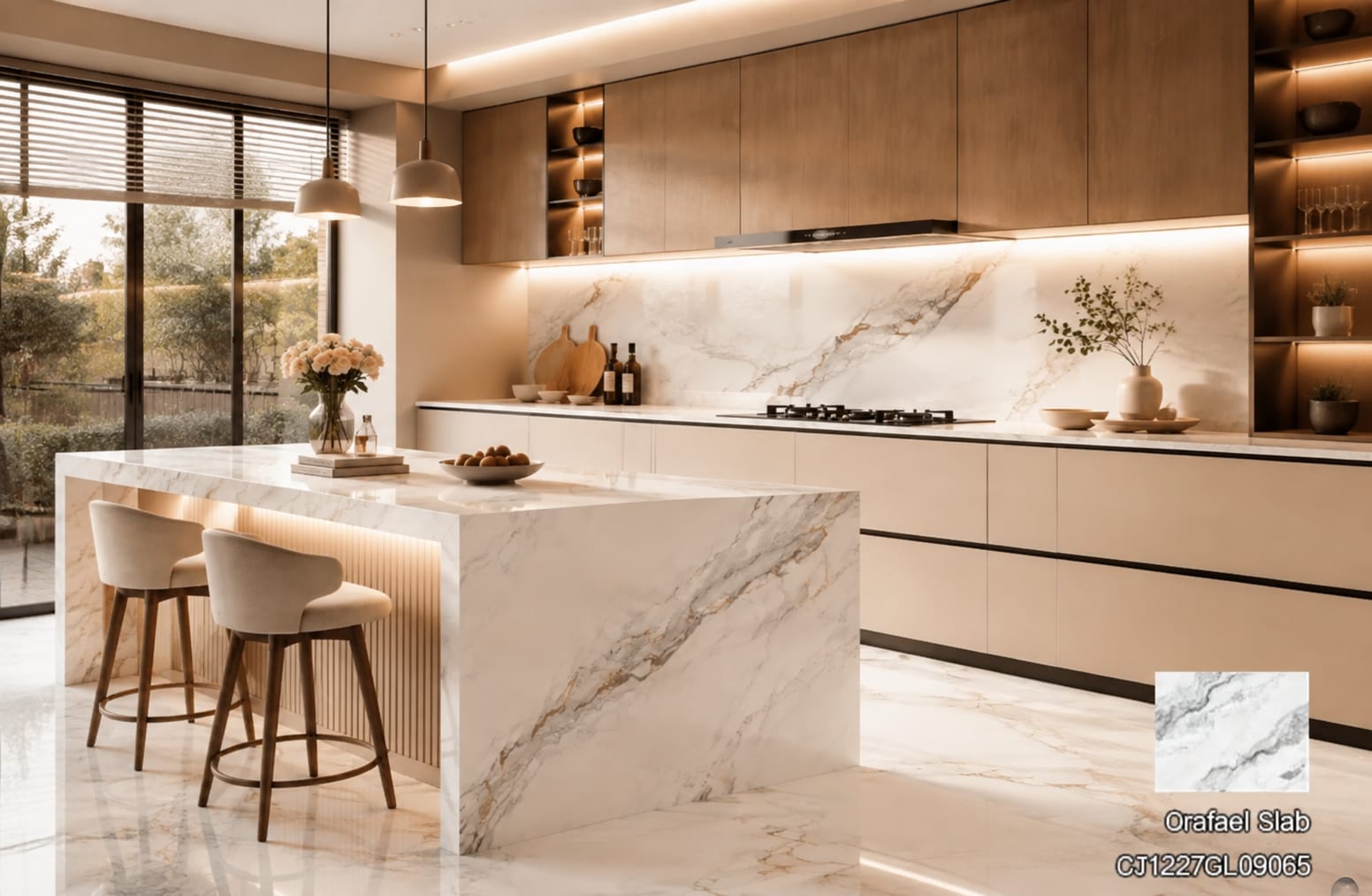
Is sintered stone fragile? Thickness is not the only factor that matters
When sintered stone chips or cracks, thickness alone is not the explanation. Internal structure, body quality, and production stability often determine cutting, drilling, and edge-finishing performance more than the millimeter figure.
When selecting sintered stone, thickness is often one of the first parameters buyers and fabricators look at. 9 mm, 12 mm, 15 mm... different thicknesses correspond to different applications and fabrication methods. In actual processing, however, even slabs of the same thickness can perform differently in cutting, hole cutting, and edge finishing. So when a slab chips, cracks, or otherwise fails during fabrication, thickness alone is not enough to explain it. What deserves more attention is the slab's own internal quality, body structure, and the stability of the production process.
1. Is the internal structure uniform?
During fabrication, sintered stone is subjected to different forms of mechanical action: cutting, drilling, and edge finishing. If the internal structure is clearly uneven, local stress concentration is more likely during processing, which raises the risk of chipping or cracking. When evaluating a sintered stone, therefore, it is not enough to look at the surface pattern. Overall internal quality and stability should also be considered.
2. Body quality affects actual fabrication performance
The same thickness does not mean every sintered stone will fabricate in the same way. Body structure, raw-material formulation, pressing, and firing all affect the finished product's performance. For projects that require extensive cutting, hole cutting, and shaped work, whether the slab can hold a stable fabrication result is more useful than simply comparing "how many millimeters."
![[object Object]](https://cdn.zylsinteredstone.com/news-is-sintered-stone-fragile-thickness-is-not-enough-02-400x225.jpg)
3. The production process matters as well
Thickness is a parameter that can be measured directly, but it does not fully reflect the quality of a sintered stone slab. From raw-material handling, spreading, and pressing through high-temperature firing, every production step affects the finished slab's stability. Especially on bulk project orders, what the procurement team should watch is not how one sample performs, but whether the same batch can maintain relatively consistent quality and fabrication performance. That is also why, when choosing a sintered stone supplier, quality control in the production process is equally worth attention.
4. Actual fabrication tests are more useful than parameters alone
If the project involves kitchen countertops, vanity tops, feature walls, stairs, or other applications that require cutting and hole cutting, an actual fabrication test can be done before the bulk purchase. For example, observe:
- The edge condition after a straight cut;
- Whether cracks tend to appear at hole-cutting locations;
- Whether the edge is prone to chipping during finishing;
- Whether performance is consistent at different fabrication positions;
- Whether there are clear differences between batches.
These actual results usually help buyers judge whether a product fits a given project more reliably than looking at the thickness figure alone.
![[object Object]](https://cdn.zylsinteredstone.com/news-is-sintered-stone-fragile-thickness-is-not-enough-03-400x225.jpg)
Sintered stone selection should not stop at "how many millimeters"
Thickness certainly matters. Different thicknesses have different requirements for application, structural design, and fabrication. But if thickness is the only measure of whether a sintered stone is "easy to fabricate," the picture is still incomplete. For importers, distributors, and project procurement teams, the following can be reviewed together before a product is confirmed: product thickness, body quality, production stability, and actual fabrication performance.
![[object Object]](https://cdn.zylsinteredstone.com/news-is-sintered-stone-fragile-thickness-is-not-enough-04-400x225.jpg)
If the project will later require extensive cutting, hole cutting, or complex fabrication, sample testing should also be done in advance, and both sides should confirm that the bulk product can meet an agreed standard. Appearance sets a project's first impression; consistent product quality decides whether later fabrication and installation can proceed smoothly. A sintered stone that truly fits a project is not just one whose specifications look right; it also has to stand up to actual fabrication.